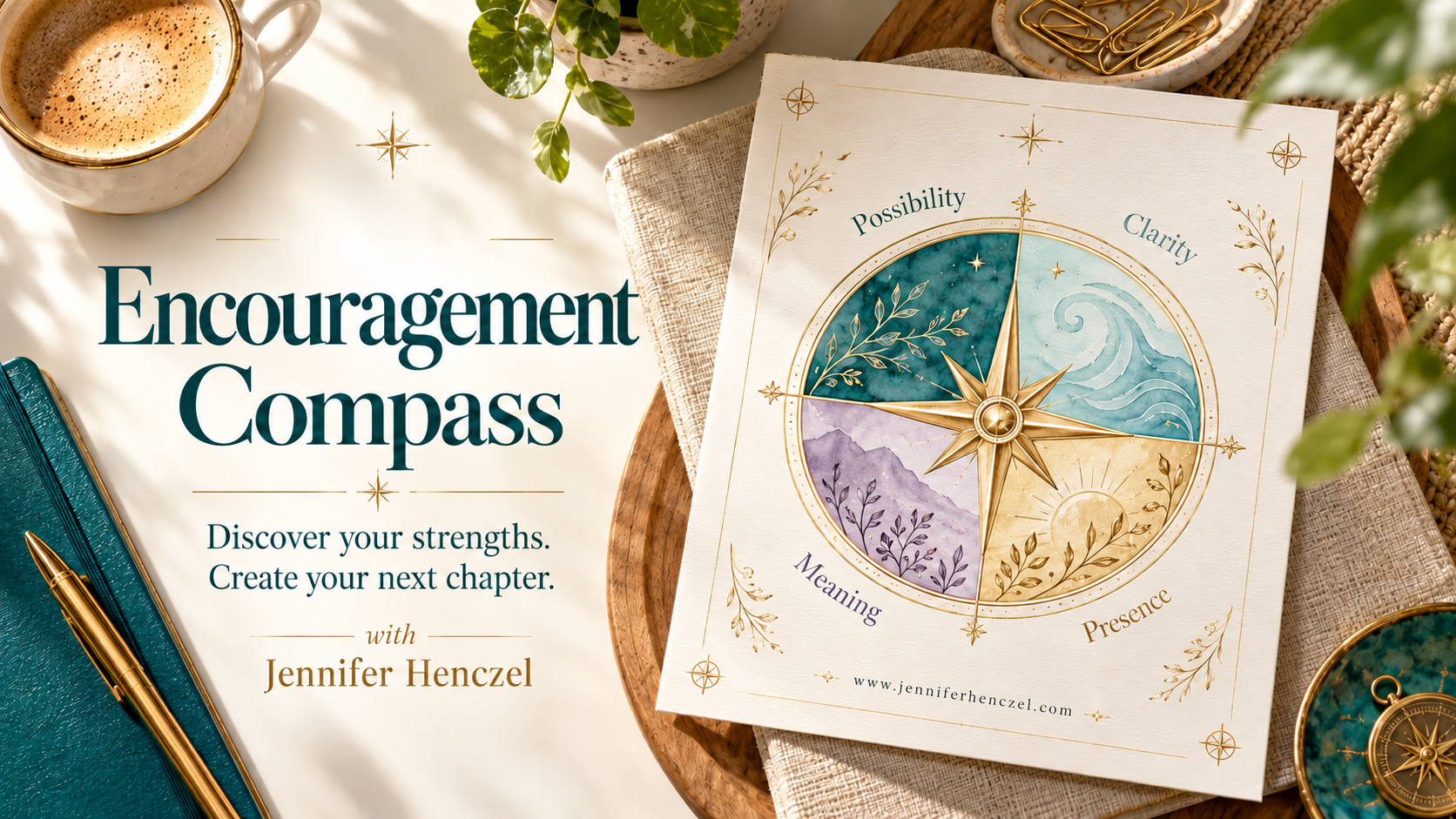
Encouragement for your next step
Encouragement Compass
Personality Assessment
Be uplifted. Find clarity and direction. Discover the strengths that make you, you. ✨
Maximize your performance and manifest better outcomes.
Possibility
The Visionary
Clarity
The Strategist
Meaning
The Connector
Presence
The Builder
Find the encouragement that fits you.
Take this free, four-minute personality assessment to receive an encouraging personal profile, appreciate your unique strengths, and explore a meaningful next step.
About 4 minutes · No right or wrong answers · A strengths-based reflection
Anonymous starts, completions and profile categories are counted. Individual answers are not stored on the server.
You will receive a personal strengths profile and a simple action prompt.
What feels most like you?
Think about your usual preferences, rather than who you feel you should be. Choose the middle option when you are unsure.
Keep the encouragement going
Your personal results are ready.
Enter your name and email to unlock your personal results and receive encouragement from Jennifer.
Your personal compass
Your four-quadrant blend
Average response for each preference, from 1 to 5. These are reflection scores, not ability scores or population rankings.
One small step for your next chapter
Three affirmations for your strengths
Read these aloud or choose one to carry with you today.
Your next chapter starts with you
Turn self-awareness
into an intentional next step.
Explore the Manifestation Vault inside Innovators Vault and give yourself space to reflect on what you want to create next.
Explore the Manifestation Vault →Opens the Innovators Vault community.
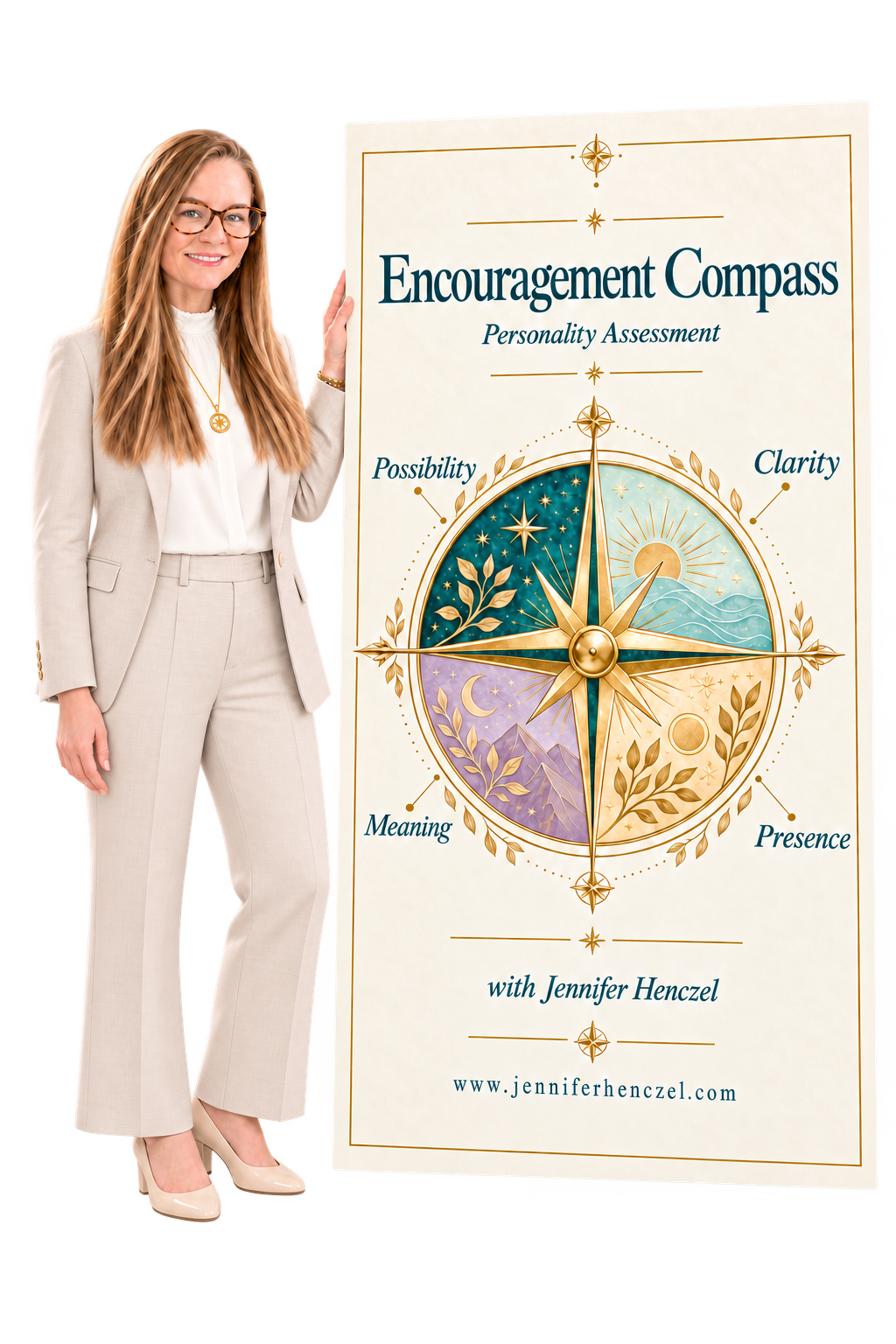
Meet the Creator
Jennifer Henczel, Queen of Encouragement
Jennifer Henczel is an award-winning podcaster, author, speaker, community builder, encouragement coach, founder of the Women Podcasters Network, Women Podcasters Awards, Vest Lady and Innovators Vault.
Jennifer helps entrepreneurs monetize their expertise through multiple streams of income. She is known for her ability to build thriving communities, and she teaches others how to do the same.
Jennifer hosts 2 podcasts: The Women in Podcasting Show and Inspiring Show.
Jennifer won the Business Podcast of the Year Award from the Podcast Awards and the Innovator of the Year Award at the Quill Podcast Awards.
Jennifer's mission is to elevate women’s voices globally and in the podcasting industry.
Join Jennifer's community →How I created this assessment & references
I created this original assessment drawing on my studies of behaviorism, adult education and personality profiling. I brought these interests together to encourage self-awareness, personal reflection and practical next steps.
The personality framework takes inspiration from Carl Jung’s four psychological functions: intuition, thinking, feeling and sensation. Here, feeling means evaluating through values, and sensation means noticing concrete experience. Everyone can use all four.
Katharine Cook Briggs and Isabel Briggs Myers later developed practical applications of Jung’s type theory. Jungian analyst John Beebe also expanded work on psychological functions and development. These are background influences, not endorsements. Our questions, scoring rules and profile names are original; this is not the MBTI®, a reproduction of another assessment, or a measure of Beebe’s model.
Each preference has five statements scored from 1 to 5, with one reverse-scored statement. The highest total identifies the most endorsed preference; exact ties are shown together, and scores within two points are described as close. These thresholds are editorial choices, not validated cutoffs. The four quadrants are a visual arrangement, not two measured axes. This short tool does not assess introversion/extraversion or assign a full Jungian type.
Use what resonates as a starting point for reflection. Context, mood and experience can change your answers. Results do not establish ability, mental health, career suitability or future success.
Adult-learning principles inform the emphasis on personal relevance, reflection and a self-chosen next step. Behaviorism informs the invitation to observe an action and what helps you repeat it. These are distinct traditions; they do not validate the personality scores.
References and further reading
- C. G. Jung — Psychological Types (1921). Background to the four psychological functions. See Fiona Ross’s overview, “Carl Jung Personality Types,” Society of Analytical Psychology.
- Katharine Cook Briggs and Isabel Briggs Myers. Historical development of personality type applications. Myers & Briggs Foundation: Evolving the MBTI Legacy.
- John Beebe — “Psychological Types” (2006), in The Handbook of Jungian Psychology. Further work on psychological functions and development, referenced in the Society of Analytical Psychology overview above.
- B. F. Skinner — Science and Human Behavior (1953). Background reading on behavior and learning. B. F. Skinner Foundation edition.
- Malcolm S. Knowles and colleagues — The Adult Learner. Adult learning, personal relevance and self-direction. Publisher’s companion resource.
References acknowledge the background ideas. No questions, scoring system or result descriptions have been reproduced from these works or commercial assessments. No affiliation or endorsement is implied.